Health-GPS

Global Health Policy Simulation model
Global Health Policy Simulation model
| Home | Quick Start | User Guide | Schemas | Models | Architecture | Data Model | Developer Guide | Technical docs | API |
Models in Health-GPS
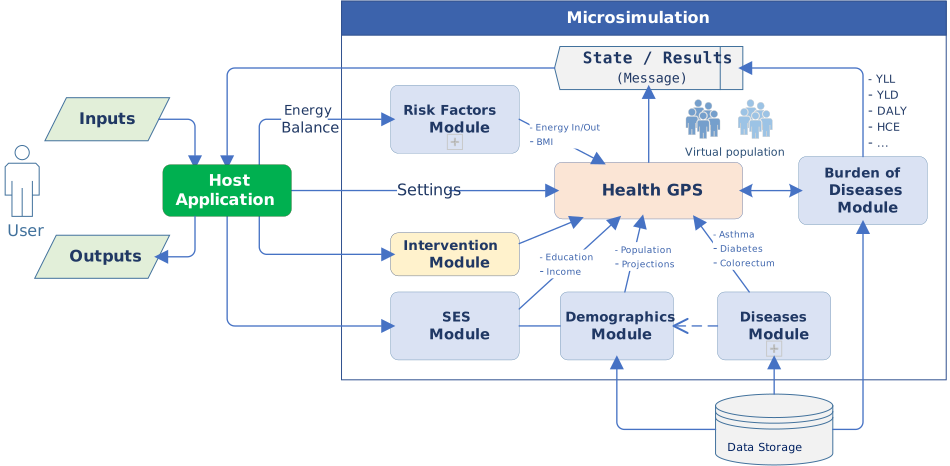
Health-GPS runs a fixed stack of simulation modules on each person. Inside the risk-factor module, config registers two model packs (two JSON files). The config keys are historically called static and dynamic; those words name roles in the pipeline, not kinds of risk factor and not “protein is static then becomes dynamic”.
For file formats and FINCH maths, see the Simulation models reference and the User Guide.
Top-level simulation modules
 |
|---|
| Demographics → SES → risk factors → diseases → outputs |
| Stage | Role |
|---|---|
| Demographics | Age, births, deaths, migration |
| SES | Continuous ses noise (not the same as income categories) |
| Risk factors | Runs the two configured model packs (see below) |
| Diseases | Incidence / prevalence from risk factors + datastore |
| Analysis / output | Aggregates and files under output.folder |
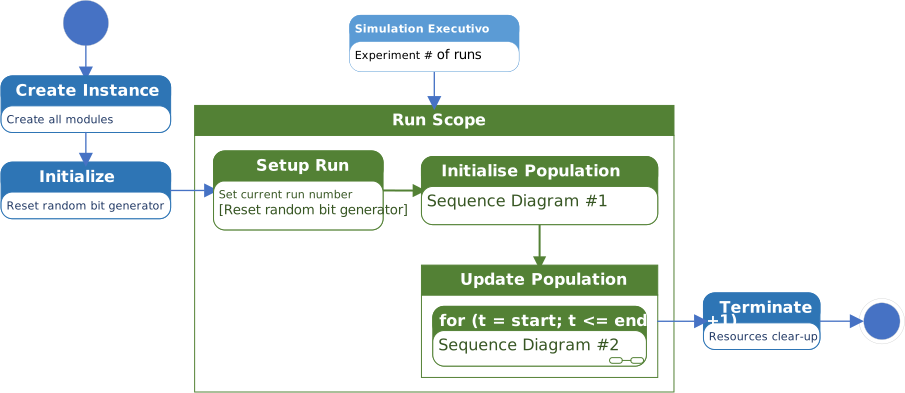
Architecture: modules, simulation engine, Software Architecture.
The confusing words: static and dynamic
In Health-GPS these are config slot names, not scientific labels for a nutrient.
| Config key | Better way to read it | What you put there | Example ModelName |
|---|---|---|---|
modelling.risk_factor_models.static |
Initialisation-oriented pack | Model that mainly creates / adjusts baseline person profiles (and still participates on yearly update for newborns and some adjustments) | hlm, staticlinear, dummy |
modelling.risk_factor_models.dynamic |
Time-update-oriented pack | Model that mainly advances physiology / risk factors through years (and also runs a generate step at init) | ebhlm, kevinhall, dummy |
"modelling": {
  "risk_factor_models": {
    "static": "new_static_model.json",
    "dynamic": "dynamic_model.json"
  }
}
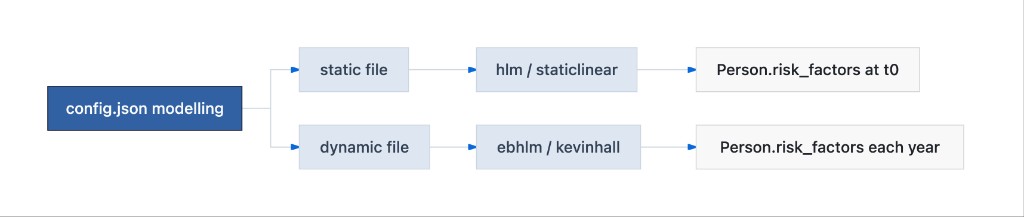
Each file’s ModelName selects the real implementation (staticlinear, kevinhall, …). That name matters more than the slot word.
What is not true
- A factor such as protein is not “a static risk factor in year 1 and a dynamic risk factor from year 2”.
- Protein (and income, PA, weight, …) are fields on the person. Different packs may write them at different times.
- “Static” does not mean “the model never changes anything later”. The initialisation-slot model still has an
update_risk_factorspath (e.g. newborns, age-18 income, factors-mean adjustment in FINCH).
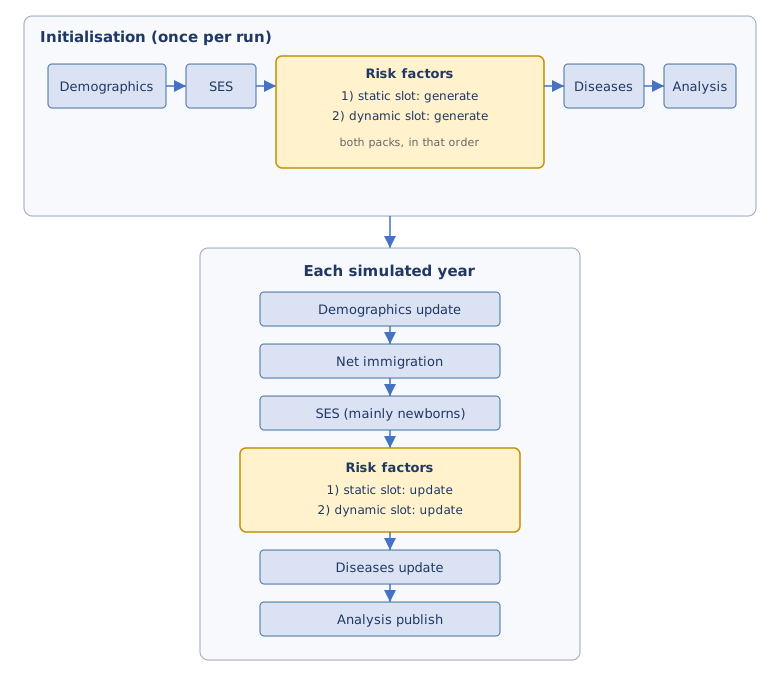
What is true (from the host module)
On initialisation, Health-GPS calls:
- initialisation-slot →
generate_risk_factors - update-slot →
generate_risk_factors
On each simulated year, it calls:
- initialisation-slot →
update_risk_factors - update-slot →
update_risk_factors
So if the update-slot is Kevin Hall, both packs still run each year; Kevin Hall is not the only code in the yellow risk-factor step. Older diagrams that show only “Static risk-factor model” at init and only “Dynamic risk-factor model” each year are oversimplified.
 |
|---|
Both config slots run at init (generate) and each year (update): static then dynamic |
FINCH-style example (answers the protein question)
Typical pair: staticlinear in the static slot + kevinhall in the dynamic slot.
| Moment | What usually happens to nutrients / weight |
|---|---|
| Start of run | staticlinear builds correlated baseline foods/nutrients, income, PA, etc.; then kevinhall initialises nutrient/energy intakes, weight, height, BMI |
| Later years | staticlinear mainly re-initialises newborns (and related adjustments); kevinhall updates intakes/weight/BMI for the continuing population |
So protein is not re-labelled “dynamic”. It is a person value that may be set by one pack and updated by another, depending on age and year.
 |
|---|
Two files, two slots; ModelName inside each file picks the implementation |
Model names (what to remember)
Prefer these implementation names when talking about science. The slot (static / dynamic) only says where the file is plugged in.
ModelName |
Usual slot | One-line description |
|---|---|---|
hlm |
static |
Hierarchical linear initialisation (STOP / France-style HLM packs). |
staticlinear |
static |
CSV / Box-Cox baseline initialiser (FINCH, India-style); income, PA, nutrients, optional stratum mean adjustment. |
ebhlm |
dynamic |
Yearly equation-based factor updates with mean alignment (legacy dynamic HLM). |
kevinhall |
dynamic |
Energy-balance updates: intakes, weight, height, BMI (FINCH / Kevin Hall India). |
dummy |
either | Test stub with fixed values / simple policy; not a scientific model. |
Common pairs:
| Project style | static slot |
dynamic slot |
|---|---|---|
| STOP / HLM France | hlm |
ebhlm |
| FINCH / Kevin Hall India | staticlinear |
kevinhall |
Schemas: static.json, dynamic.json. Worked inputs/outputs: Simulation models reference.
Other configured pieces (not ModelNames)
| Area | Config / data | Role |
|---|---|---|
| Income & demographics | project_requirements, CSVs under modelling |
Region, ethnicity, income category, quintile adjustment |
| Baseline adjustments | modelling.baseline_adjustments |
Factors-mean calibration (optional income strata) |
| Interventions | running scenarios + policy CSVs |
Policy levers in the intervention run |
| PIF | population_impact_fraction |
Optional incidence scaling |
| Datastore diseases | Backend data_index + running disease list |
Country rates and relative risks |
Where to go next
| Need | Document |
|---|---|
| How a person is built and updated | How Health-GPS models a person |
Full inputs/outputs per ModelName |
Simulation models reference |
| FINCH linear models & income | FINCH guide |
| JSON examples | User Guide — Risk factor models |
| Example packs | HealthGPS-examples |
Author: Mahima Ghosh